
Verifying Land Rights, Rightsholders, and Property: Our Veridian + Cardano Prototype Is Ready!
We’re thrilled to announce that Landano’s Project Catalyst Fund 12 project — Implementing the Cardano Foundation Identity Wallet in Landano — is successfully complete. After nearly two years of design, building, problem-solving, and testing, we have a working prototype that does something genuinely new, and we’ve made it open to everyone. This is a small step with big implications. Here’s what we built, why it matters, and where it goes next. Why this matters Implementing real-world solutions on the Cardano blockchain has never been more important. And the insecurity of home and property is only growing, as climate, political, and economic pressures combine into a worsening global problem of housing and tenure security. Landano was founded to take on both challenges at once — and this project is a real, working piece of that mission. Expanding land rights security around the world works best when anyone, anywhere can reliably prove three things, without depending on a central gatekeeper: We built, demonstrated, and openly released a working prototype that performs all three checks, end to end — using the Cardano Foundation’s Veridian identity wallet, KERI/ACDC credentials, and Cardano-native NFTs. While we designed it with low-documentation, low-institutional-trust environments like rural Africa in mind, the result is built for broad applicability across many regions and use cases. Here’s a short video explaining the project, and showing it in action: The Mendix application can be found on our public Github repository: https://github.com/landano/mendix-veridian-prototype What we built: three foundational use cases The prototype proves out three fundamental use cases, each an essential building block of a working decentralized identity (DID) verification system connecting Veridian, a Mendix-built application, and Cardano NFTs: 1. Identity credential issuance. An authority — in our demo, a local Chief — issues an identity credential to a user, such as a landowner or other rights holder. The Chief approves it directly on their own device, and the private key never leaves their hands. 2. NFT ownership verification. A third-party verifier can confirm that a user holds the Cardano NFT representing rights to a specific parcel of land or other real property — with ownership proven by a fresh cryptographic challenge, not just a database lookup. 3. Wallet balance verification. Because real transactions usually involve a transfer of funds alongside a transfer of rights, the prototype lets a party confirm that a claimed Cardano wallet balance actually exists — so both sides can transact with confidence. Together, these three checks make up the backbone of trustworthy, self-sovereign identity verification for real-world assets. Open source, and ready to build on We’ve released the prototype as an open-source Mendix plugin under the Apache 2.0 license, so developers across both the Cardano and Mendix ecosystems can accelerate their own DID projects rather than starting from scratch. That’s the part we’re most excited about. By offering an adaptable, open framework, we hope to draw more real-world asset projects onto Cardano — a robust alternative for teams seeking the right open identity platform, at a moment when many other digital wallet efforts are struggling with adoption. It’s a meaningful reason for the 300,000+ active Mendix developers to build on Cardano. You can find the code, fork it, and make it your own here: github.com/landano/mendix-veridian-prototype Tested, and proven We didn’t just build it — we put it through its paces. Each of the three use cases was tested multiple times, along with a regression test of a previously issued credential. In total, 15 test instances were run, and every one passed — a 100% success rate. You can dig into the test results here. Stakeholder Feedback We also gathered outside perspectives. Feedback from potential users and interested parties is always best practice for any new product, and this prototype plugin is no different. We invited roughly 70 stakeholders — Mendix developers, blockchain security experts, and property rights and real estate professionals — to watch the prototype in action and share structured and open feedback. Responses were collected over two weeks in June 2026. Feedback was overwhelmingly positive, affirming the successful operability of all three use cases. Just as valuably, reviewers reinforced our attention toward what matters most for the road ahead: staying aligned with Veridian as it matures, hardening the system for real-world conditions like poor connectivity and lost-wallet recovery, sharpening the security and trust model around the custodial wallet, and demonstrating the concept’s reach beyond land rights. We’re grateful for every one of those insights — they sharpen both our own next steps and those of anyone who builds on our work. What comes next This prototype is deliberately a foundation, not a finished endpoint. A few capabilities were intentionally out of scope, and stand out as natural next steps: From here, we’ll spread the word throughout the Mendix community, and we’d be delighted to see this evolve into a polished, production-ready offering on the Mendix Marketplace — available to any of those hundreds of thousands of builders who need decentralized, trustworthy identity verification for their own projects. With gratitude This success was not ours alone. We owe a strong and heartfelt thank-you to Fergal O’Connor, Identity Solutions Lead Architect, and Javier Franco, Senior Technical Program Manager, both of the Cardano Foundation, for their significant contributions of thought, resources, and problem-solving. And our sincere thanks to Project Catalyst for making the work possible. At Landano, we believe property rights should be accessible to everyone, regardless of where they live or who they know. Today, we’re one real step closer to making that a reality.
Milestone 2 Delivered: Verifiable Land Rights with Veridian and Cardano

We’ve reached an important checkpoint in our Project Catalyst Fund 12 work: Milestone 2 of “Implementing the Cardano Foundation Identity Wallet in Landano” is complete and signed off. Every test case passes, every critical bug we found has been resolved, and the prototype is ready for demonstration. This post is a short tour of what Milestone 2 actually proves, why it matters for property rights on Cardano, and where to dig deeper. What we set out to demonstrate Land rights only work if people can prove three things, reliably and without a central gatekeeper: Milestone 2 is a working prototype that performs all three checks end-to-end, using the Veridian identity wallet (Cardano Foundation), KERI/ACDC credentials, and Cardano-native NFTs. A quick look at the prototype The screenshot below is from our Milestone 2 demo video. On the right, the Landano application running in Mendix shows a Chief’s dashboard: their AID prefix, alias, LEI, and OOBI. On the left, a phone running Veridian shows the incoming signing request that the Chief approves to issue a credential to a Representative. If you’d rather watch it run, the full walkthrough is here: The Mendix application can be found on our public Github repository: https://github.com/landano/mendix-veridian-prototype The three use cases we delivered 1. Verifying Landano user identity A traditional Chief, acting as a self-sovereign root of trust, issues an ACDC credential to a community Representative through Veridian. The credential carries an LEI sourced from the Chief’s wallet contact, follows the IPEX Apply / Grant flow, and lands in the Representative’s wallet with status Issued. Failures (for example, a contact without an AID) are caught and surfaced cleanly. 2. Verifying ownership of a Landano NFT A Land Owner mints a Cardano NFT that represents their parcel. The mint is signed twice: once with their KERI AID in Veridian and once with their Cardano wallet through CIP-30. Both signatures, plus the binding payload and the KERI challenge SAID, are written into the NFT’s onchain_metadata. A Verifier can then confirm three things in one flow: the NFT is still held by the original wallet, the KERI challenge is fresh and approved, and the Cardano signature is valid against the expected payload. 3. Verifying that a wallet balance belongs to the identity holder Same dual-signature pattern, applied to wallet binding instead of an asset. A Verifier can confirm that a specific Cardano address — and the ADA balance returned by Blockfrost — really belongs to the person behind a given KERI identity. Test results Test cases executed 15 Pass rate 100% Issues found and resolved 9 Critical bugs fixed 1 (CIP-30 payload validation) Test environment Mendix Studio Pro 11.6.2 · Cardano preprod · KERIA (Cardano Foundation testnet) · Veridian wallet (customisation on top of 1.2.0) Test date 22 April 2026 The full test report and the 15 individual test cases are attached below. What we fixed along the way The most important fix was a CIP-30 verification bug where a valid signature on the wrong payload would have been accepted. We now extract the payload from the COSE_Sign1 structure and compare it to the expected value before trusting the signature. We also corrected hex/bech32 handling in the Cardano integration, replaced a flawed Blockfrost import mapping with a direct OkHttp + Jackson call to handle 64-character chunked metadata, and tightened the domain model so that issuer and receiver associations on credentials are explicit rather than inferred. These look like small things written down. They’re the kind of small things that decide whether a verification system can actually be trusted. What’s intentionally still open A few items are out of scope for this prototype and earmarked for follow-up work: The Veridian wallet used in testing is a Landano build on top of version 1.2.0; behaviour may differ from the production Cardano Foundation Identity Wallet release. Why this matters Property rights only become real when they survive scrutiny. A title that can’t be checked is a title that can be disputed. By combining KERI-based identity, ACDC credentials, and Cardano’s settlement layer, we get a way to verify identity, ownership, and control without relying on a single authority — and without exposing more personal data than the verification actually needs. Milestone 2 is the smallest end-to-end version of that idea that we can ship. We’re now turning toward presentation flows, transfer mechanics, and the next round of field validation. Resources
When Paper Burns: Ukraine’s War, Land Rights, and the Case for Blockchain

In moments of war, a society’s foundations are tested in the harshest ways. Ukraine’s experience since Russia’s 2022 invasion is a powerful example — a nation torn apart not only by the immediate violence of tanks and missiles, but also by the quiet, lasting devastation of losing what people own. Property rights are not merely technical. They are the bedrock of dignity, belonging, and future investment. When families cannot prove their claim to a piece of land or a roof over their heads, they lose far more than an asset — they lose their security, their future, and often their very identity. A 2022 rapid needs assessment, published with contributions from the Global Land Alliance, De Montfort University, the Kyiv School of Economics, and other partners, lays bare the scale of the problem: This is not a uniquely Ukrainian story. This is a global cautionary tale. Paper Titles Are No Match for Fire, Flood, or War For centuries, land ownership has depended on physical deeds. Paper is cheap, simple, and — in peacetime — reliable enough. But it is also fragile. War shows how quickly paper burns. Floods show how quickly it dissolves. Corruption shows how easily it can be stolen, forged, or hidden away. In Ukraine, the vulnerability of paper-based systems has been tragically exposed. Before the war, only about 40% of property titles were fully digitized in the national electronic registry. Many rural and older urban properties still depended on Soviet-era documents or on local archives. When Russian troops and artillery destroyed city halls, regional land offices, and court buildings, thousands of records vanished with them. Even in the best-case scenario, recovering paper deeds from bombed-out buildings is impossible. That means millions of Ukrainians will be forced to enter lengthy, uncertain, and often corrupt restitution systems to prove that the land or house they lived in for generations truly belonged to them. What Ukraine Teaches the World Ukraine’s tragedy is a profound lesson for the global land rights movement. From Sudan to Syria, Haiti to Pakistan, natural disasters, climate change, and conflict threaten land tenure every year. It is not an exaggeration to say that hundreds of millions of people globally live on land that is only as secure as a piece of paper in a local drawer. In fragile and conflict-affected regions, this becomes a license for the powerful — whether armed groups, criminal networks, or corrupt officials — to grab land from the powerless. When a person cannot produce a document to prove ownership, they often have no practical means to fight back. Ukraine’s policy assessment specifically called for digitization of archives, creation of interoperable databases, and even the use of remote-sensing data to help validate ownership. These are important steps. But they still suffer from one fundamental weakness: they rely on centralized systems. Servers can be hacked or physically destroyed. Governments can be captured or corrupted. Blockchain: Resilience by Design That is why Landano’s mission matters. Blockchain is not just a digital ledger — it is a resilience technology. Unlike a traditional database stored on one or two servers, blockchain distributes copies of every record across a global network. No single failure, no single bomb, no single corrupt official can alter or erase it. Imagine if Ukraine’s land records had been recorded on blockchain before the war. A farmer in Donbas, displaced to Poland or Germany, could still cryptographically prove her claim. A bank in Lviv could instantly verify the ownership of a damaged apartment for compensation claims. Insurance payouts could be triggered automatically by smart contracts tied to trusted damage reports. Blockchain makes fraud nearly impossible because records cannot be changed without cryptographic consensus. Ownership is transparent, traceable, and auditable by anyone who needs to see it. Most importantly, it is borderless — it works even when physical government offices are destroyed or occupied. Landano’s Vision Landano was founded on a simple but powerful idea: that people deserve land records that cannot burn, drown, or vanish. We believe land is more than an asset — it is the foundation of generational wealth, stability, and community. When that foundation is fragile, society is fragile. By leveraging blockchain, Landano seeks to build a new standard for property rights: Tamper-proof: no one can alter your title without consensus.Globally accessible: titles recoverable even in exile.Disaster-resistant: no flood, fire, or war can destroy the chain.Community-owned: local authorities and communities can co-govern the system. These features directly answer the vulnerabilities laid bare by Ukraine’s war. They are not theoretical. They are the natural evolution of land rights technology. Policy Reflections from Ukraine The Ukrainian government, to its credit, is working to build a more modern land system in the aftermath of invasion. According to the rapid needs assessment, officials have: These efforts are vital. But as the policy brief notes, they face severe challenges: Landano’s approach could complement these efforts. A blockchain-based property registry could act as a trust anchor, providing verifiable, unalterable records that integrate with national systems while guaranteeing resilience beyond them. A Global Wake-Up Call For the rest of the world, Ukraine should serve as a wake-up call. We cannot wait for the next war, hurricane, or flood to wipe out land records before modernizing. We need to build secure, decentralized, community-driven registries now, before the next disaster strikes. Consider these examples: Haiti, after the 2010 earthquake, faced years of bitter land disputes because property archives were buried in rubble.Pakistan, after the 2022 floods, saw entire villages unable to prove land rights when paper deeds washed away.Syria, with entire towns displaced, struggles with proving ownership of farmlands amid lost or falsified records. In all these places, blockchain could have given survivors the ability to stand on solid ground, legally and financially. A Human Right to Proof At its heart, this is about human dignity. Land is more than dirt and concrete. It is where your ancestors lived, where your children will grow, where your memories reside. When you lose proof of your land, you lose the ability to protect your family’s past
Canadian Company Launches Groundbreaking Land Management App in Ghana
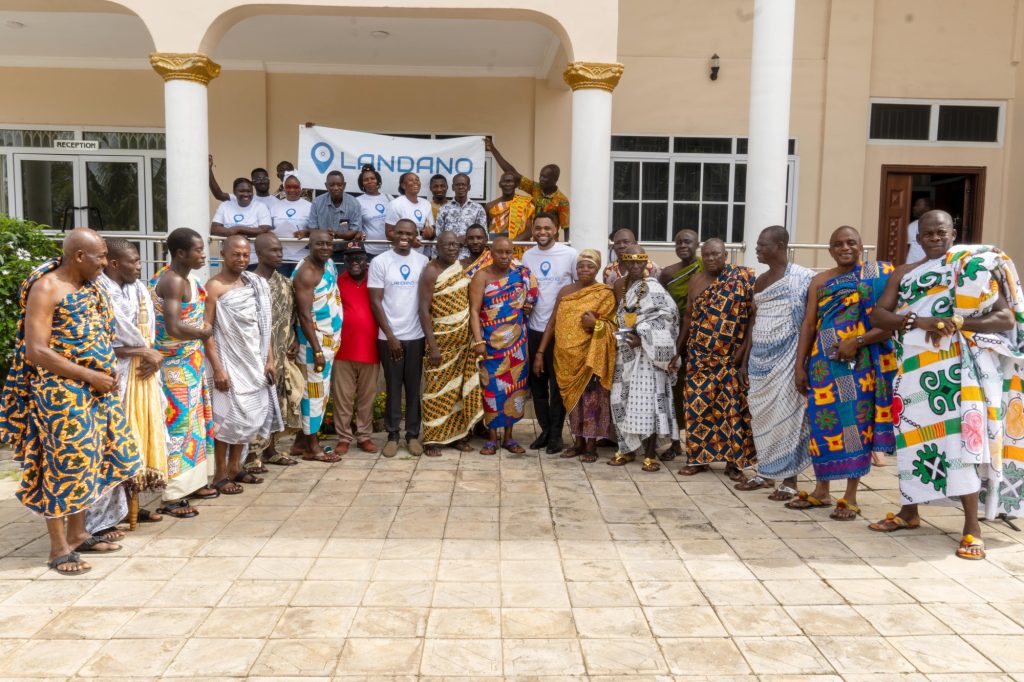
Landano International, a Canadian‑based company, is committed to breaking the barriers in Ghana’s land management system. Tackling Ghana’s Long-Standing Land Conflict Crisis For years, land management has been a significant challenge in Ghana, leading to numerous conflicts and social issues. Research by Ebenezer Ankomah Gyamera PhD, in 2016, found that land cases constitute about 59 percent of total court cases in Ghana, with an average increase of 25 percent in cases every year. Disturbingly, only 10 percent of these cases are settled every year. The findings also concluded that the major cause of land conflict is the sale of land to multiple owners. Given this, Landano International has developed a robust mobile application that monitors and reports in real time the details of land ownership. Stakeholder Engagement with Traditional Leaders In a stakeholders summit with Adansi chiefs at Adansi Asokwa in the Ashanti region of Ghana, Nana Kwadwo Safo, Ghana’s Community Ambassador for Landano, explained that an in‑depth study has been conducted to understand the problem at hand, and he is optimistic that their robust system will put an end to these issues. “Our main goal is to curb the conflicts associated with land management. Our team of experts, after extensive research and deliberation, has developed a platform that enables landowners to manage and track their lands on their phones, eliminating the need for travel. This will help traditional leaders to know who owns what land and also prevent the sale of a single land to multiple owners.” He further stated that Landano will be working collaboratively with the Lands Commission and the Department of Stool Lands to ensure that land conflicts become a thing of the past using their state‑of‑the‑art application. A Vision for Transparency and Collaboration Present at the gathering was Dan Junior Amankona, the Chief Commercial & Marketing Officer of Landano, who underlined the importance of openness and collaboration. He stated: “Our unity here today is inspired by a common love for Ghana and its people. It is truly a privilege and a blessing to collaborate with such visionary leaders. As the son of the chief of Kato, a town in the Bono region, I am deeply familiar with the challenges that chiefs encounter as they strive to elevate their communities. At Landano, we pride ourselves on valuing the insights of chiefs and their constituents, and we aspire to deliver a sustainable solution to Ghana’s land management systems. Our model will ultimately facilitate the connection of chiefs and landowners with international funding opportunities that would foster the development of Ghana’s communities and economy.” The Excitement of Nananom The overjoyed Gyasehene of Bodwesango in the Ashanti region of Ghana, Nana Adu Gyamfi III, described the day as one of the happiest days of his life. He stated that being able to manage, monitor, and track land on a mobile phone is a novelty to him, and it is something that would be embraced wholeheartedly. He believes this innovation is a game‑changer and will definitely solve land disputes. Nana Akwasi Buaben, the Gyaasehene of Adansi Dompoase, also alluded to the fact that for years, chiefs all over Ghana have had issues managing their lands, especially with setting boundaries. However, with the assurance and training given, he is optimistic that it will be a thing of the past. He used the opportunity to heap praises on the Landano team and pledge support for the project. Institutional Support from the Stool Lands Secretariat On the part of the Stool Lands Secretariat, Dr. Isaac Osei Boahen, Adansihene Stool Lands Manager, stated that his office will benefit greatly from the project. He believes that boundary issues, which cause a lot of conflicts, will be solved and ultimately result in an increase in revenue generation. Core Challenges in Ghana’s Land Administration Stool lands in Ghana constitute about 80% of land holdings in Ghana, but have consistently been plagued with: Landano’s Blockchain-Based Approach The Landano team believes that these issues can be improved by introducing its higher‑quality, blockchain‑based records management for land administration using sustainable web3 software. Pilot Project Success in Rural Ashanti Region Landano embarked on its innovative pilot project in March 2022, focusing on community outreach in the rural Ashanti region, specifically the town Hiawu Besease. This groundbreaking initiative was led by their talented Head Geospatial Engineer, Abdul Razak, who brought his extensive experience and unique expertise to the fore. The project focused on land management systems, leveraging technology to improve accuracy, transparency, and efficiency. It integrated elements of local knowledge, cultural norms, and legal guidelines, aiming to strike a balance between modern methods and traditional practices. This comprehensive endeavour aimed not only to enhance the productivity and sustainability of the land but also to empower the local communities by involving them directly in the process. The end goal of this pioneering work was to provide a blueprint for similar projects in other rural regions, thereby contributing significantly to the broader economic development of Ghana. In attendance at the summit were chiefs from Adansi Fomena division, Adansi Dompoase division and Bodwesango division. The full complement of the project is expected to be released soon.