
Verifying Land Rights, Rightsholders, and Property: Our Veridian + Cardano Prototype Is Ready!
We’re thrilled to announce that Landano’s Project Catalyst Fund 12 project — Implementing the Cardano Foundation Identity Wallet in Landano — is successfully complete. After nearly two years of design, building, problem-solving, and testing, we have a working prototype that does something genuinely new, and we’ve made it open to everyone. This is a small step with big implications. Here’s what we built, why it matters, and where it goes next. Why this matters Implementing real-world solutions on the Cardano blockchain has never been more important. And the insecurity of home and property is only growing, as climate, political, and economic pressures combine into a worsening global problem of housing and tenure security. Landano was founded to take on both challenges at once — and this project is a real, working piece of that mission. Expanding land rights security around the world works best when anyone, anywhere can reliably prove three things, without depending on a central gatekeeper: We built, demonstrated, and openly released a working prototype that performs all three checks, end to end — using the Cardano Foundation’s Veridian identity wallet, KERI/ACDC credentials, and Cardano-native NFTs. While we designed it with low-documentation, low-institutional-trust environments like rural Africa in mind, the result is built for broad applicability across many regions and use cases. Here’s a short video explaining the project, and showing it in action: The Mendix application can be found on our public Github repository: https://github.com/landano/mendix-veridian-prototype What we built: three foundational use cases The prototype proves out three fundamental use cases, each an essential building block of a working decentralized identity (DID) verification system connecting Veridian, a Mendix-built application, and Cardano NFTs: 1. Identity credential issuance. An authority — in our demo, a local Chief — issues an identity credential to a user, such as a landowner or other rights holder. The Chief approves it directly on their own device, and the private key never leaves their hands. 2. NFT ownership verification. A third-party verifier can confirm that a user holds the Cardano NFT representing rights to a specific parcel of land or other real property — with ownership proven by a fresh cryptographic challenge, not just a database lookup. 3. Wallet balance verification. Because real transactions usually involve a transfer of funds alongside a transfer of rights, the prototype lets a party confirm that a claimed Cardano wallet balance actually exists — so both sides can transact with confidence. Together, these three checks make up the backbone of trustworthy, self-sovereign identity verification for real-world assets. Open source, and ready to build on We’ve released the prototype as an open-source Mendix plugin under the Apache 2.0 license, so developers across both the Cardano and Mendix ecosystems can accelerate their own DID projects rather than starting from scratch. That’s the part we’re most excited about. By offering an adaptable, open framework, we hope to draw more real-world asset projects onto Cardano — a robust alternative for teams seeking the right open identity platform, at a moment when many other digital wallet efforts are struggling with adoption. It’s a meaningful reason for the 300,000+ active Mendix developers to build on Cardano. You can find the code, fork it, and make it your own here: github.com/landano/mendix-veridian-prototype Tested, and proven We didn’t just build it — we put it through its paces. Each of the three use cases was tested multiple times, along with a regression test of a previously issued credential. In total, 15 test instances were run, and every one passed — a 100% success rate. You can dig into the test results here. Stakeholder Feedback We also gathered outside perspectives. Feedback from potential users and interested parties is always best practice for any new product, and this prototype plugin is no different. We invited roughly 70 stakeholders — Mendix developers, blockchain security experts, and property rights and real estate professionals — to watch the prototype in action and share structured and open feedback. Responses were collected over two weeks in June 2026. Feedback was overwhelmingly positive, affirming the successful operability of all three use cases. Just as valuably, reviewers reinforced our attention toward what matters most for the road ahead: staying aligned with Veridian as it matures, hardening the system for real-world conditions like poor connectivity and lost-wallet recovery, sharpening the security and trust model around the custodial wallet, and demonstrating the concept’s reach beyond land rights. We’re grateful for every one of those insights — they sharpen both our own next steps and those of anyone who builds on our work. What comes next This prototype is deliberately a foundation, not a finished endpoint. A few capabilities were intentionally out of scope, and stand out as natural next steps: From here, we’ll spread the word throughout the Mendix community, and we’d be delighted to see this evolve into a polished, production-ready offering on the Mendix Marketplace — available to any of those hundreds of thousands of builders who need decentralized, trustworthy identity verification for their own projects. With gratitude This success was not ours alone. We owe a strong and heartfelt thank-you to Fergal O’Connor, Identity Solutions Lead Architect, and Javier Franco, Senior Technical Program Manager, both of the Cardano Foundation, for their significant contributions of thought, resources, and problem-solving. And our sincere thanks to Project Catalyst for making the work possible. At Landano, we believe property rights should be accessible to everyone, regardless of where they live or who they know. Today, we’re one real step closer to making that a reality.
Milestone 2 Delivered: Verifiable Land Rights with Veridian and Cardano

We’ve reached an important checkpoint in our Project Catalyst Fund 12 work: Milestone 2 of “Implementing the Cardano Foundation Identity Wallet in Landano” is complete and signed off. Every test case passes, every critical bug we found has been resolved, and the prototype is ready for demonstration. This post is a short tour of what Milestone 2 actually proves, why it matters for property rights on Cardano, and where to dig deeper. What we set out to demonstrate Land rights only work if people can prove three things, reliably and without a central gatekeeper: Milestone 2 is a working prototype that performs all three checks end-to-end, using the Veridian identity wallet (Cardano Foundation), KERI/ACDC credentials, and Cardano-native NFTs. A quick look at the prototype The screenshot below is from our Milestone 2 demo video. On the right, the Landano application running in Mendix shows a Chief’s dashboard: their AID prefix, alias, LEI, and OOBI. On the left, a phone running Veridian shows the incoming signing request that the Chief approves to issue a credential to a Representative. If you’d rather watch it run, the full walkthrough is here: The Mendix application can be found on our public Github repository: https://github.com/landano/mendix-veridian-prototype The three use cases we delivered 1. Verifying Landano user identity A traditional Chief, acting as a self-sovereign root of trust, issues an ACDC credential to a community Representative through Veridian. The credential carries an LEI sourced from the Chief’s wallet contact, follows the IPEX Apply / Grant flow, and lands in the Representative’s wallet with status Issued. Failures (for example, a contact without an AID) are caught and surfaced cleanly. 2. Verifying ownership of a Landano NFT A Land Owner mints a Cardano NFT that represents their parcel. The mint is signed twice: once with their KERI AID in Veridian and once with their Cardano wallet through CIP-30. Both signatures, plus the binding payload and the KERI challenge SAID, are written into the NFT’s onchain_metadata. A Verifier can then confirm three things in one flow: the NFT is still held by the original wallet, the KERI challenge is fresh and approved, and the Cardano signature is valid against the expected payload. 3. Verifying that a wallet balance belongs to the identity holder Same dual-signature pattern, applied to wallet binding instead of an asset. A Verifier can confirm that a specific Cardano address — and the ADA balance returned by Blockfrost — really belongs to the person behind a given KERI identity. Test results Test cases executed 15 Pass rate 100% Issues found and resolved 9 Critical bugs fixed 1 (CIP-30 payload validation) Test environment Mendix Studio Pro 11.6.2 · Cardano preprod · KERIA (Cardano Foundation testnet) · Veridian wallet (customisation on top of 1.2.0) Test date 22 April 2026 The full test report and the 15 individual test cases are attached below. What we fixed along the way The most important fix was a CIP-30 verification bug where a valid signature on the wrong payload would have been accepted. We now extract the payload from the COSE_Sign1 structure and compare it to the expected value before trusting the signature. We also corrected hex/bech32 handling in the Cardano integration, replaced a flawed Blockfrost import mapping with a direct OkHttp + Jackson call to handle 64-character chunked metadata, and tightened the domain model so that issuer and receiver associations on credentials are explicit rather than inferred. These look like small things written down. They’re the kind of small things that decide whether a verification system can actually be trusted. What’s intentionally still open A few items are out of scope for this prototype and earmarked for follow-up work: The Veridian wallet used in testing is a Landano build on top of version 1.2.0; behaviour may differ from the production Cardano Foundation Identity Wallet release. Why this matters Property rights only become real when they survive scrutiny. A title that can’t be checked is a title that can be disputed. By combining KERI-based identity, ACDC credentials, and Cardano’s settlement layer, we get a way to verify identity, ownership, and control without relying on a single authority — and without exposing more personal data than the verification actually needs. Milestone 2 is the smallest end-to-end version of that idea that we can ship. We’re now turning toward presentation flows, transfer mechanics, and the next round of field validation. Resources
Landano Technical Architecture: What’s New In 2024
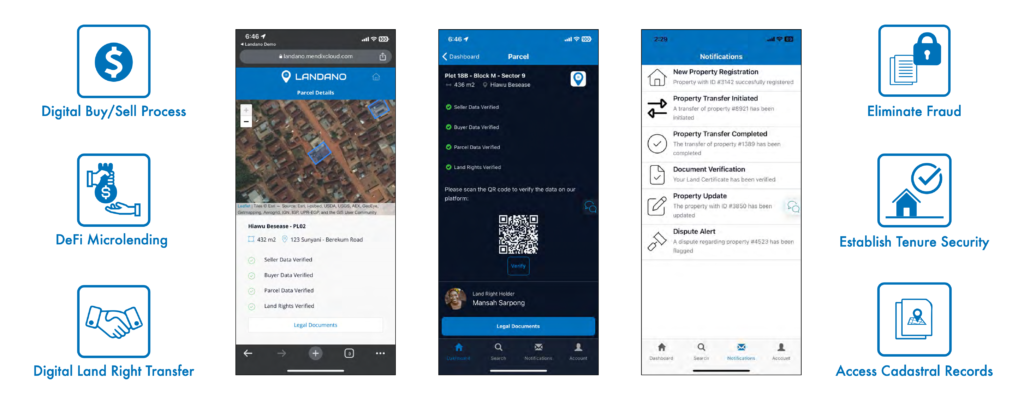
Landano is a software platform for creating and managing decentralized land right records using the Cardano blockchain. We created a proof-of-concept application during Landano’s kick-off stage in 2022. We eased from software development in 2023 to focus on better understanding our potential user base, business opportunities, and matching up to investor profiles. We’ve summarized a lot of that activity in this update video. The Landano project is now ready to combine these efforts into a Minimum Viable Product that will perform core Landano functions on Testnet first before launching on Cardano Mainnet for our users in Ghana and Mozambique. This is a good time to check-in behind the curtains and get a better understanding of the technology architecture we’re implementing to deliver the Landano software platform in 2024. The Mendix Solution The Landano MVP we created in 2022 was developed using the Mendix low-code platform. Our CTO Dorus van der Kroft is a senior Mendix consultant and is leading the development and implementation of the Landano software. Over the course of the past two years we did investigate a number of other candidate technologies on which to build our off-chain components to interact with our on-chain Cardano code. However, Mendix is the right fit for a platform like ours, which we consider to be in the enterprise software market, given that we intend to onboard millions of users. Mendix is primarily used to create and manage large portfolios of business-critical applications across organizational and technical boundaries. It is an integrated application platform-as-a-service (aPaaS) offering for designing, building, deploying, and managing enterprise apps. Mendix is classified by Gartner as a low-code application platform that solves complex software development at scale and with speed. Mendix applications are cloud native by default making all components built on the platform very scalable, resilient, and portable. The low-code methodology also means developers can use Mendix to deliver software quickly to ensure that products and services are brought to market faster while optimizing operational processes. The platform is accessible to developers and administrators through the Developer Portal, which provides access to apps as well as services for requirements management, development, and deployment in the operation and administration of apps and app services. The platform includes Mendix Studio Pro as well as the Mendix Marketplace, which features hundreds of publicly available building blocks to speed up development. The Landano project received a Project Catalyst Fund 11 grant recently to leverage the work we have done so far with our Landano platform to create generic Cardano plugins for the Mendix Marketplace using our Landano code. This will allow the large ecosystem of Mendix enterprise developers to use Cardano NFTs and smart contracts from within the Mendix development environment directly. This sub-project holds a lot of potential for bringing in new enterprise software development talent into the Cardano ecosystem. Mendix allows our Landano team to develop on one core code base and use it to deliver both desktop and mobile applications. You can find the most recent version of our mobile apps in this Github repo. Keep in mind that this is still the experimental proof-of-concept version at the moment. Deployment Architecture Mendix Cloud is a PaaS-based cloud offering based on Cloud Foundry technology that runs on the IaaS layer of Amazon Web Services. Our Landano Mendix application runs in a container provided by Cloud Foundry. These have standard support for horizontal and vertical scaling as well as auto-healing. Scaling up and down can be done without any downtime by simply adding or removing containers. The Mendix Cloud Foundry layer is deployed in multiple availability zones for each AWS region. An availability zone is a physical data-center location of AWS within a region. A Mendix application needs a database and file storage to operate. In the Mendix Cloud, these aPaaS services are directly consumed from the AWS service layer. For the database, the Mendix Cloud makes use of RDS PostgreSQL, and for the file storage, it makes use of S3. Both of these services are Multi-AZ configured, so data is replicated across data centers. All this Mendix infrastructure is used as a processing pipeline for the Landano application modules. There are no permanent records stored within the Mendix platform. The records generated by Landano are stored as Cardano NFTs with supporting documentation packages provided on the permissionless Arweave storage network. This is described further below. The Landano platform and the Mendix plug-ins we are creating allow low-code developers to combine the best of battle-tested enterprise software with the trust guarantees provided by the decentralized Cardano blockchain through its eUTXO NFTs and smart contracts. Domain-driven Development Mendix enables model-driven development through Mendix Studio Pro, which provides visual drag-and-drop development tools for workflows, user interfaces, data, logic, and navigation using no-code and low-code development. Mendix interprets the resulting model at runtime thereby maintaining the bond between model and application which improves greatly upon managing legacy code and technical debt once a platform is in production. Direct model execution also removes code generation overhead and provides significant advantages by accommodating live changes and consistency checks, controlled extensions, and dynamic monitoring analysis at runtime. The Land Administration Domain Model (LADM) Landano software and record-keeping requirements are ISO standards compliant to ensure the sustainability, interoperability, credibility and legal value of the land right documentation it creates and manages. The foundational model that drives the Landano domain is based on ISO standard 19152, the Land Administration Domain Model (LADM). The LADM provides a standardized global vocabulary and entity model for land administration. It has become the predominant reference standard for land administration software systems. Landano has implemented the LADM as a Mendix domain underpinning our business logic. In addition to managing the domain model, Mendix Studio allows our developers to create responsive user interfaces from a declarative interface. This helsp to ensure standardized browser compliance across the various device interfaces that Landano is accessible on. The last component of note is the Mendix-Arkly interface. Arkly is a platform developed in collaboration with the Landano team to provide permanent, decentralized document storage on the Arweave network. Blockchain applications