
When Paper Burns: Ukraine’s War, Land Rights, and the Case for Blockchain

In moments of war, a society’s foundations are tested in the harshest ways. Ukraine’s experience since Russia’s 2022 invasion is a powerful example — a nation torn apart not only by the immediate violence of tanks and missiles, but also by the quiet, lasting devastation of losing what people own. Property rights are not merely technical. They are the bedrock of dignity, belonging, and future investment. When families cannot prove their claim to a piece of land or a roof over their heads, they lose far more than an asset — they lose their security, their future, and often their very identity. A 2022 rapid needs assessment, published with contributions from the Global Land Alliance, De Montfort University, the Kyiv School of Economics, and other partners, lays bare the scale of the problem: This is not a uniquely Ukrainian story. This is a global cautionary tale. Paper Titles Are No Match for Fire, Flood, or War For centuries, land ownership has depended on physical deeds. Paper is cheap, simple, and — in peacetime — reliable enough. But it is also fragile. War shows how quickly paper burns. Floods show how quickly it dissolves. Corruption shows how easily it can be stolen, forged, or hidden away. In Ukraine, the vulnerability of paper-based systems has been tragically exposed. Before the war, only about 40% of property titles were fully digitized in the national electronic registry. Many rural and older urban properties still depended on Soviet-era documents or on local archives. When Russian troops and artillery destroyed city halls, regional land offices, and court buildings, thousands of records vanished with them. Even in the best-case scenario, recovering paper deeds from bombed-out buildings is impossible. That means millions of Ukrainians will be forced to enter lengthy, uncertain, and often corrupt restitution systems to prove that the land or house they lived in for generations truly belonged to them. What Ukraine Teaches the World Ukraine’s tragedy is a profound lesson for the global land rights movement. From Sudan to Syria, Haiti to Pakistan, natural disasters, climate change, and conflict threaten land tenure every year. It is not an exaggeration to say that hundreds of millions of people globally live on land that is only as secure as a piece of paper in a local drawer. In fragile and conflict-affected regions, this becomes a license for the powerful — whether armed groups, criminal networks, or corrupt officials — to grab land from the powerless. When a person cannot produce a document to prove ownership, they often have no practical means to fight back. Ukraine’s policy assessment specifically called for digitization of archives, creation of interoperable databases, and even the use of remote-sensing data to help validate ownership. These are important steps. But they still suffer from one fundamental weakness: they rely on centralized systems. Servers can be hacked or physically destroyed. Governments can be captured or corrupted. Blockchain: Resilience by Design That is why Landano’s mission matters. Blockchain is not just a digital ledger — it is a resilience technology. Unlike a traditional database stored on one or two servers, blockchain distributes copies of every record across a global network. No single failure, no single bomb, no single corrupt official can alter or erase it. Imagine if Ukraine’s land records had been recorded on blockchain before the war. A farmer in Donbas, displaced to Poland or Germany, could still cryptographically prove her claim. A bank in Lviv could instantly verify the ownership of a damaged apartment for compensation claims. Insurance payouts could be triggered automatically by smart contracts tied to trusted damage reports. Blockchain makes fraud nearly impossible because records cannot be changed without cryptographic consensus. Ownership is transparent, traceable, and auditable by anyone who needs to see it. Most importantly, it is borderless — it works even when physical government offices are destroyed or occupied. Landano’s Vision Landano was founded on a simple but powerful idea: that people deserve land records that cannot burn, drown, or vanish. We believe land is more than an asset — it is the foundation of generational wealth, stability, and community. When that foundation is fragile, society is fragile. By leveraging blockchain, Landano seeks to build a new standard for property rights: Tamper-proof: no one can alter your title without consensus.Globally accessible: titles recoverable even in exile.Disaster-resistant: no flood, fire, or war can destroy the chain.Community-owned: local authorities and communities can co-govern the system. These features directly answer the vulnerabilities laid bare by Ukraine’s war. They are not theoretical. They are the natural evolution of land rights technology. Policy Reflections from Ukraine The Ukrainian government, to its credit, is working to build a more modern land system in the aftermath of invasion. According to the rapid needs assessment, officials have: These efforts are vital. But as the policy brief notes, they face severe challenges: Landano’s approach could complement these efforts. A blockchain-based property registry could act as a trust anchor, providing verifiable, unalterable records that integrate with national systems while guaranteeing resilience beyond them. A Global Wake-Up Call For the rest of the world, Ukraine should serve as a wake-up call. We cannot wait for the next war, hurricane, or flood to wipe out land records before modernizing. We need to build secure, decentralized, community-driven registries now, before the next disaster strikes. Consider these examples: Haiti, after the 2010 earthquake, faced years of bitter land disputes because property archives were buried in rubble.Pakistan, after the 2022 floods, saw entire villages unable to prove land rights when paper deeds washed away.Syria, with entire towns displaced, struggles with proving ownership of farmlands amid lost or falsified records. In all these places, blockchain could have given survivors the ability to stand on solid ground, legally and financially. A Human Right to Proof At its heart, this is about human dignity. Land is more than dirt and concrete. It is where your ancestors lived, where your children will grow, where your memories reside. When you lose proof of your land, you lose the ability to protect your family’s past
Implementing Landano in Kenya

Landano has been conducting pilot projects in rural Ghana and Mozambique to drive the requirements and design of our Minimum Viable Product (MVP) software release. We believe that technology for its own sake is a lost opportunity, and that land administration projects designed and built without first understanding the socio-cultural context in which they will be deployed are inevitably limited in their ability to spark societal change and improvement. Instead, development must be informed by an on-the-ground understanding of the people, their culture, and the systems the technology is designed to interact with. This principle continues to guide our activities in Ghana, Mozambique, and is now being applied in our project’s approach to land right issues in Kenya. The Landano Difference Over the last two centuries, the relationship between land and people has become increasingly influenced by the desire to leverage it for economic development. However, this commodification of land is challenged by historically held perspectives that see the relationship between humans and land as a continuum– one that connects us to the sacred world. In many communities in sub-Saharan Africa, land as a resource is held communally with the intention of leveraging it for more than just personal and economic gain. Landano is not trying to replace centralized government registry functions or force marginalized people to accept European systems and norms. Rather, Landano is providing a world-class, user-driven technology platform that enables the continuation and prosperous evolution of the types of traditional land rights practices that have been in place in Sub-Saharan Africa for millennia. Wherever possible, we leverage favourable land right legislation. Creating standards-compliant records for previously undocumented but constitutional land rights is the key distinguishing feature of the Landano solution that sets it apart from prior, unsuccessful attempts to use blockchain technology for land registration (e.g. see Anash, 2023). After achieving independence from their European colonizers, both Ghana and Mozambique enacted new constitutions that recognize the authority of traditional leaders, like village chiefs and family heads. These leaders make authoritative decisions on their community’s behalf about how their land is used. These countries enjoy a “pluralistic” legal system which attempts to marry traditional land right practices with the more bureaucratic cadastral systems put in place by their European colonizers. This has not been an easy integration. Traditional rights all too often fall victim to predatory practices of political and social elites who exercise their control and privilege within the centralized cadastral system and its technology-intensive components. Landano is giving traditional communities a fighting chance by leveling the playing field. Our world-class recordkeeping system is compliant with international standards and national laws. However, it is also simple enough to be accessed by users with limited literacy or digital experience. Better yet, the land right records it generates can be leveraged to open up previously inaccessible lending and financial opportunities by safeguarding land right transactions. One of these opportunities, which we are assessing now, is to connect our users to DeFi microfinance opportunities on the Cardano blockchain. Landano is positioning itself to be a world-wide land administration solution, to bring land tenure security and new financial opportunities wherever they are needed. We have been looking beyond Ghana and Mozambique to expand into jurisdictions with similar histories and opportunities. Of course, Africa is a rich and complex continent with many different cultures, languages, and norms. This holds true for land management as well. What may be applicable in one location may not be valid elsewhere, whether in another nation state or in another village. Therefore, it is important to establish a sound understanding of the socio-juridical history of a particular region before attempting to introduce new systems. One of our pilot project deliverables is a way to incorporate such context into a jurisdiction/internationalization template to port the Landano technology to new markets. Land Administration In Kenya Kenya is an East African country with an incredibly diverse population of over 53 million people that represent many of the continent’s major ethno-racial groups including the Bantus, Nilotic, and Cushitic peoples. In fact, the country’s most recent population and housing census recognized 45 different ethnicities residing in Kenya (National Bureau of Statistics, 2022). The Bantu-speaking ethnic groups make up about 60%, Nilotic-speaking ethnic groups make up about 30%, Cushitic ethnic groups covering another 9%, and less than 1% of the population consists of citizens of European, Middle Eastern, and Asian descent. Each of these individual ethnic groups, within broad linguistic groupings, had (and still have) their own unique relationships with land. These are influenced by a variety of factors, including societal traditions, the seasons, or topographic features in the surroundings. Communities from the same ethnic groups can even differ in these relationships; for example, Bantu-speaking ethnic groups living near bodies of water such as rivers, lakes, or the Indian Ocean, differ in how they relate to the land than other Bantu-speaking ethnic groups. However, what they have in common is that each of these groups has historically held land communally and allocated resources within the community as needed. This changed with colonization in the 19th century, and the impact of this shift dramatically changed the varied relationships held between humans and land across Kenya. Land Administration Under The British Almost immediately after the Imperial British East Africa Company first arrived in Kenya in 1888, the British elite began to seize the land which they assessed as having future economic value. In order to formalize their right to these lands, the British Crown enacted an ordinance in 1902 known as the Registration of Documents CAP 285 (Kenya, 2022) which effectively replaced traditional land administration systems with one that favored the colonizers. In 1920, Kenya was annexed as a British Dominion and became known as the Colony and Protectorate of Kenya. More land was taken and reserved for settlers. With the need to allocate and sell land, additional statutory instruments were enacted to support these processes. Land administration activities such as cadastral mapping were carried out to transform land from communal assets to the statutory freehold for
Improving Land Security In Mozambique
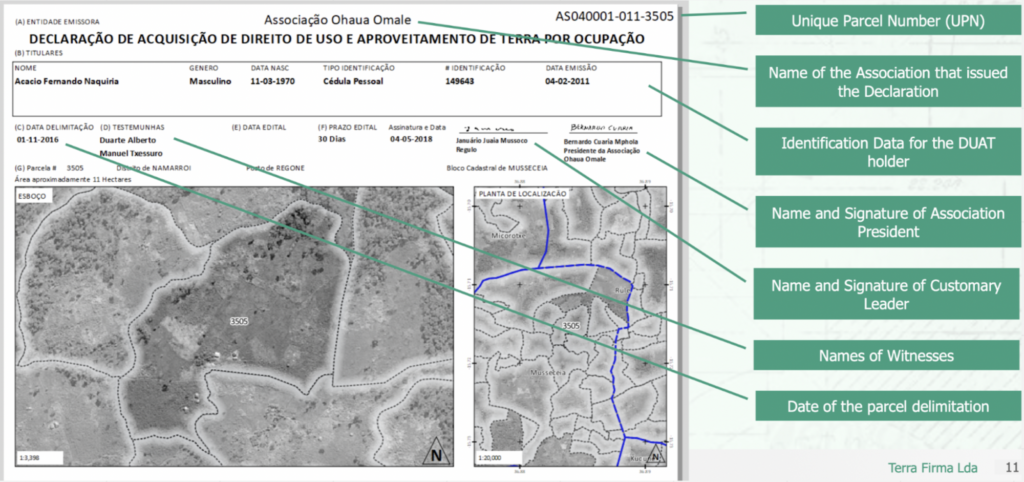
If communities mapped their own territories, would land disputes decrease? Does land tenure security improve economic opportunities within marginalized societies? How do trustworthy, reliable land right records empower people? These key research questions are being answered through the pioneering work done by a Landano partner in Mozambique. The CaVaTeCo System Terra Firma is a land-based consultant group based in Mozambique that has developed the Community Land Value Chain (CaVaTeCo) system to equip communities with the ability to map and document ownership of land and natural resources (Landano, 2022). The CaVaTeCo approach utilizes inexpensive tools, like handheld GPS devices and open-source GIS software to encourage community members to engage with the mapping of their traditional lands (Terra Firma, 2018). This innovative project uses a bottom-up approach to land governance and property rights for individuals living in rural areas. This makes it a perfect match for Landano’s own methodology and tools which are now being integrated to add blockchain notarization and DeFi access to CaVaTeCo. Terra Firma has developed CaVaTeCo to take advantage of the unique regulatory environment in Mozambique. There have been an array of major policy decisions that have shaped land administration in this country, including the 1990 Constitution, the National Land Policy of 1995, the Land law of 1997, the Rural Land law of 1998, and more (Norfolk, 2020). Accordingly, land in Mozambique can be divided into two major categories: public lands which are maintained by the government, and community lands maintained by rural communities. The Land law of 1997 enables community-declared right declarations (DUATs). These allow members of local communities to obtain individual plots of land within community lands with the approval of local leaders (USAID, 2018). The CaVaTeCo system has formalized and provided structure to these DUAT declarations. To connect these DUATs and the corresponding parcels of land to DeFi opportunities, they will be minted on the Cardano blockchain as non-fungible tokens (NFT) using the Landano platform. Mozambican government agencies and private companies view communities as participants in land management and administration but not as rights-holders (Meij, 2022). This is problematic for individuals seeking to express autonomy over their land and securing opportunities for economic mobility. The rural population of Mozambique includes over twenty million people, ninety-five percent of whom live and farm on land which remains unmapped and undocumented (Tabary, 2018). This creates inherent challenges to proper allocation of land, documentation of land transfers, and equitable distribution of natural resources. Often, individuals living in these areas are unable to access the national land administration system due to the remoteness and cost of travel to government land offices, unaffordable fees for various agents and processes, and a range of bureaucratic and I.C.T. shortcomings. Currently, for most villages throughout Mozambique, land and farms are passed down through family or via informal agreements of land transfers, which are rarely documented (World Bank, 2014). These informal agreements around land management and administration can lead to violence if there is a dispute. Individuals living throughout Mozambique recognize the need for formalized documentation of land. During a 2017 World Bank mapping project in the small town of Meitor, one resident noted, “documentation has planted seeds of trust in the community. And with that trust comes opportunities for cooperation.” (Pimentel, 2020) This lack of documentation excludes rural populations from leveraging their land rights to improve their economic and social security. Tenure security informs people’s livelihoods and decision-making, such as whether to make financial investments into land-based businesses like farms and shops. (Tabary, 2020) In fact, excluding individuals from accessing land rights and tenure security has a multi-generational impact on communities. Land ownership is vital to the development of intergenerational wealth. Documentation of these rights in a trustworthy digital format enables them to build a path out of poverty and access mortgages, lines of credit, and decentralized finance (DeFi) products such as business loans. The Terra Firma and Landano partnership As an independent registry of land rights that mints ISO standards compliant records on the Cardano blockchain, Landano has become a key partner to Terra Firma and its mission. The two teams are now working to import CaVaTeCo land title records and cadastral map data, mint Cardano NFTs of each DUAT record, publish all available mapping data, register new land title records, as well as transfer and verify land ownership rights. We will also make these maps publicly available for access and re-use outside of the Landano platform by local communities and government agencies. Landano is a solution to the data quality problem in land administration. It provides reliable, open data to support land management in an easy-to-query, mobile-friendly interface supported by maps, permanent archival records, and authenticity proofs that use blockchain notarization (NFTs). Landano is excited and proud to collaborate with the Terra Firma team in Mozambique and to further enhance the significant real world impact their work has already made.